How the Study Was Conducted
A rigorous, globally informed approach to understanding access to dermatological care.The SkinObservatory study brings together international expertise and data from around the world to assess access to dermatological care. Explore how the survey was developed, how data were collected and analysed, and the methods used to build a reliable picture of global access to skin health services.
Survey Development
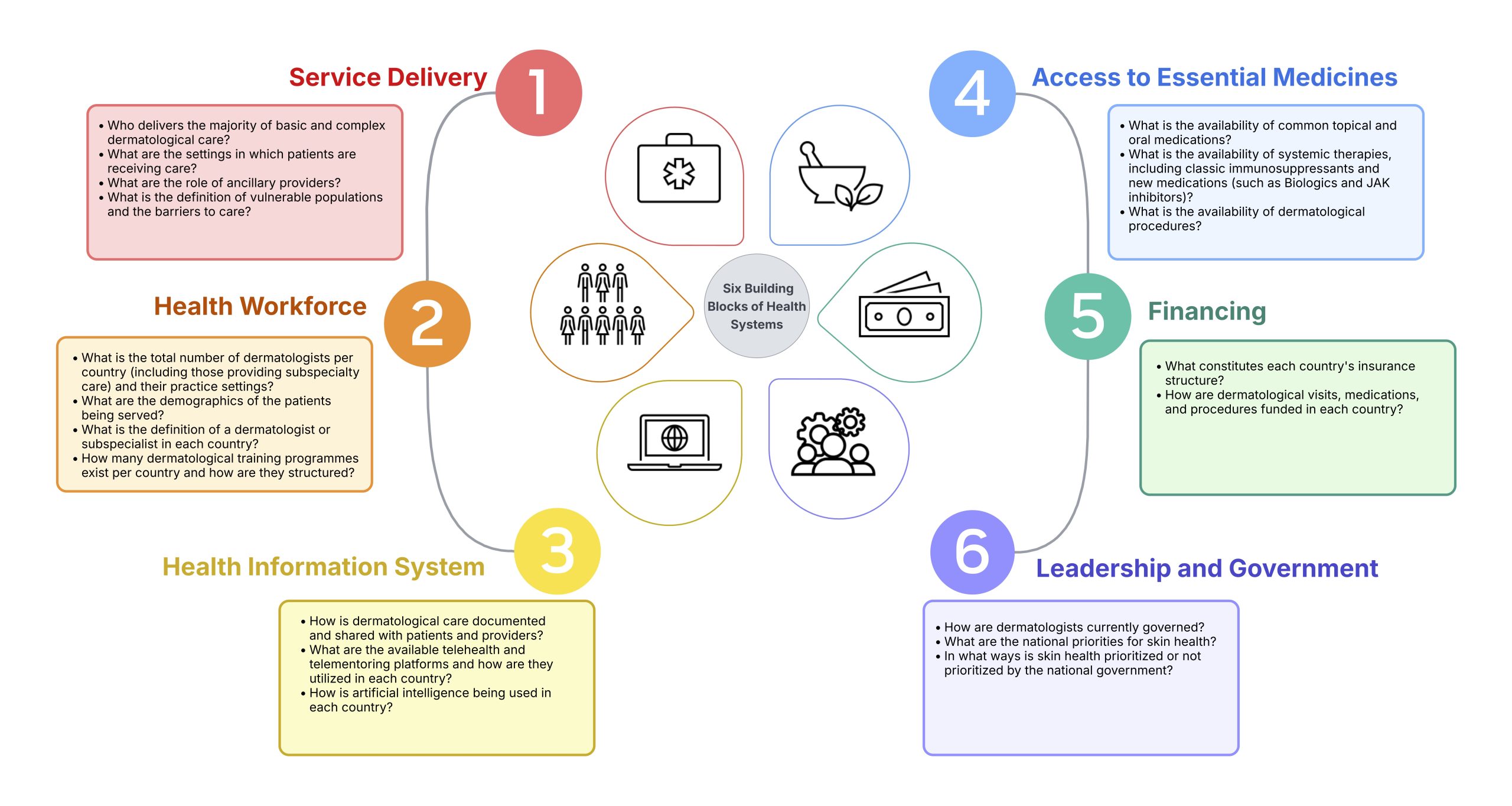
This group worked together to develop an approach to assess and describe access to care across societies with vastly different health care infrastructures, financial constraints, and national priorities. We utilized the WHO’s health system ‘Building Blocks’ framework (see below), adapted for dermatology, to identify key components of health systems to capture, as well as the Global Kidney Atlas as a model for how to map specialty care worldwide. To ensure cultural competency and adequate scope, we then conducted a two-round modified Delphi process with our steering committee and regional directors, using a 75% agreement threshold to refine and finalize the questions.
The result was the official 47-question SkinObservatory survey, available in English, French, Spanish, and Portuguese.
Data Collection & Analysis
The survey was distributed online via REDCap through the ILDS, with data collection and follow-up between August 2024- October 2025. It was distributed across 197 geographic areas including 194 WHO member states and three additional geographic areas: the occupied Palestine territory, Chinese Taipei (Taiwan) and Hong Kong, China. Henceforth, we will refer to these geographic units as “countries” for the sake of brevity.
Surveys were administered to key dermatologic stakeholders in each country. For countries with ILDS member societies, they were distributed to society leaders and presidents. For countries without ILDS member societies, they were distributed to leaders of other national dermatology societies or individuals identified by our global network of collaborators. In countries without dermatologists, surveys were distributed to WHO country program officers.
The primary outcome measures of interest included (1) the density of dermatologists per 100,000 population per country; and (2) the estimated total number of dermatologists worldwide. Secondary outcomes captured additional aspects of dermatology access and health care system capacity, including dermatology training programs, specialty care (pediatric, surgical, dermatopathology, cosmetic), and the extent to which skin health is recognized as a national health priority.
Descriptive statistics were used to report means and frequencies and non-parametric tests were used to compare outcomes across WBI levels and WHO regions. To estimate the number of dermatologists worldwide, we used an interactive two-way ANOVA test to predict the number of dermatologists for countries that did not report a total and summed this with the total number of dermatologists from reporting countries. Statistical analyses were conducted using STATA/SE (version 18.0), R (version 4), and SAS (version 9.4).
Limitations
This survey relied on input from dermatology leaders around the world with varying degrees of access to verified statistics on their country’s workforce, thereby requiring estimation in cases where official data was limited. To account for this, we asked respondents to indicate their perceived certainty regarding their responses and data sources. While over 80% of respondents indicated they were very certain or certain of their responses, and confirmed that their responses were informed by data, one-third of respondents indicated their number of dermatologists was an estimate or guess, leading to potential inaccuracies. While 158 countries completed the survey, not every respondent answered every question. Due to its broad reach across multiple cultural contexts, including among participants completing the survey in a language other than their primary language, some questions may have been interpreted differently. Finally, as this survey was limited to key informants, it does not reflect patient experience.
To further explore these findings and compare dermatology access metrics across countries and regions, we invite you to explore the SkinObservatory Data Explorer Page. For those interested in learning more about the study’s development and methodology, a detailed description is available in our recently published JAMA Dermatology article (reference link).